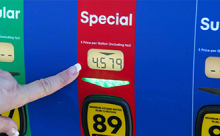
They survive sun, rain, fingers, and the occasional splash of unleaded. Fuel pump overlays aren’t just printed stickers, they’re engineered survival gear for the outside world. Let’s dive into the layers, inks, and innovations behind the scenes.
Layer 1 – Base Film
Fuel pump graphics are designed with durability in mind, and to do that, it’s best to start with the best products. Polycarbonate is a great product for clarity and rigidity; however, a raw piece of polycarbonate would have a tough time standing up to the elements.
Chemical and Scratch Resistance
When selecting a base film, understanding if the material can hold up to the chemicals it might encounter, such as splashes of diesel, is important. Polycarbonate, in its raw state, is not chemical resistant, and over a short period of time, the film will degrade. It is important that a hardcoated option is selected, which will help protect the surface of the material from chemical exposure as well as abrasions.
UV Resistance
Polycarbonates are not naturally UV-resistant and will become brittle and yellow over time. Selecting a product with UV inhibitors in the coating is important to keep your graphic looking bright and fresh for the expected life span of the overlay.
To get the best combination of film, chemical and UV-resistance, Tekra recommends:
LEXAN™ HP12W: A matte, weatherable polycarbonate with hardcoat properties for chemical and abrasion resistance.
LEXAN™ HP92W: A clear, weatherable polycarbonate with hardcoat properties for chemical and abrasion resistance.
Layer 2 – Ink Receptive Coating and Inks
While some fuel pump graphics are still screen printed, many are moving towards digital print methods. The most common digital print method for the fuel pump market is UV Inkjet. While UV Inks will stick to polycarbonate without a print-receptive coating, they don’t form a very strong bond.
We recommend Tekra’s Jetview™ UV coating for polycarbonate. This product will help:
- Reduce edge shattering for ease of die-cutting
- Avoid ink-delamination during installation
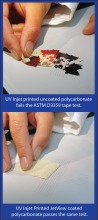
- Pass ASTM D3359 cross hatch tape test for ink adhesion
This specialty coating that is designed to enhance ink adhesion with a chemical bond to the substrate.
Layer 3- Adhesive
The next layer is adhesive. A transfer tape is applied on top of the inks and will stick directly to the fuel pump panel. But with so many adhesive options, selecting an appropriate tape can be tricky.
Tekra offers a wide range of transfer tapes for a wide variety of applications, however a high-performance acrylic adhesive is the best choice for this type of graphic overlay. It bonds well to high-surface energy plastics, such as polycarbonate and bonds well to metal. Additionally, this series performs well in the elements and will withstand hot and cold temperatures without field failure.
We recommend an option from 3M’s 200MP series of transfer tapes. The 3 most common types are:
467MP: This is clear 2.3 mils of adhesive on a #58lb PCK Liner. This is a high-performance acrylic laminating adhesive, which is commonly used for graphic overlays. The thinner adhesive makes it a more economical choice but may be better suited for smaller graphic applications.
468MP: This is a clear 5.2 mil high performance acrylic adhesive, with the same qualities to the 467MP. However, the thicker adhesive allows for better wet-out when applied, making it ideal for textured or uneven surfaces, such as a fuel pump panel.
7966MWS: This is a white, high-performance, acrylic adhesive that is offered two-sided that will really make your graphics ‘pop’! The two adhesive layers are separated with a clear polyester film, offering 5 mils of adhesive for the fuel-pump panel side of the material, and 2 mil of adhesive to apply directly to the graphic panel.
The thinner adhesive against the polycarbonate side allows for an optimal bond without excessive force being applied to the ink. Meanwhile the 5-mil adhesive provides the additional wet-out properties, allowing for optimal bond to uneven metal surfaces.
The differential in adhesive thicknesses per side optimizes the adhesion and the overall longevity of the product, as well as allows for ease of installation. The white adds opacity, ensuring your colors are clean and vibrant.
Layer 4 – Liner
This layer seems irrelevant, as it is not included in the final construction of the fuel pump, but don’t be fooled, ensuring your adhesive is on a liner that allows for proper installation is paramount.
PCK Layflat Liners: ‘PCK’ stands for ‘Polycoated Kraft Paper’. These are liners with a slightly heavier weight, with a coating which keep the material from curling due to temperature changes and humidity. This provides dimensional stability during processing and application.
Micro-Channeled Liner: There are liners that offer a micro-channel, which embeds a pattern into the adhesive. This allows the adhesive to be applied to the graphic, without having full surface contact immediately. Creating some space allows for air to be pushed out after application, reducing the risk of bubbles and allowing for some ease of adjustments during installation.
Final Product:
So now that you know all the layers and the best way to make the graphic, what specifically do you order?
We recommend you call your Tekra representative to discuss your specific application, including print method, assembly methods, and field location, as product suggestions may vary. However, we do suggest you consider our our UV printable, UV resistant Polycarbonate, if it meets your specifications, as its high-quality coating, allows for an outstanding print, which will last years in the field, out-performing standard polycarbonates, and improving operational efficiency.
With Tekra’s help, you will know that your product will be the best product.
For more information or additional assistance selecting the right products for your fuel pump application, call your Tekra Representative at 800-448-3572.